Vynce Breakdown · The Frank file

She invented 4 million customers. JPMorgan paid $175 million.

This is the court filing behind the video, and a map of it: every claim, the page it is on, and the exact line. Tap any line to open that page of the filing.

Open the full filing (PDF, 31 pages) Original on sec.gov
SEC v. Charlie Javice and Olivier Amar, No. 1:23-cv-02795 (S.D.N.Y.), Amended Complaint, Document 41, filed July 12, 2023. A U.S. government document and public record. A complaint states what the SEC alleges; the verdict and sentence below come from the Justice Department.

The map

  1. 01Page 2 of 31 · ¶3

    She paid a professor to invent 4 million customers.

    Page 2, ¶3: Javice paid a university professor to create fake data appearing to
  2. 02Page 18 of 31 · ¶80

    JPMorgan Chase paid $175 million for them.

    Page 18, ¶80: total consideration of $175
  3. 03Page 8 of 31 · ¶26

    Her startup claimed 4 million users.

    Page 8, ¶26: “4.25 million students choose Frank.”
  4. 04Page 12 of 31 · ¶48

    JPMorgan asked for the list.

    Page 12, ¶48: a list of Frank’s customer accounts
  5. 05Page 11 of 31 · ¶45

    She had about 300,000.

    Page 11, ¶45: fraction—approximately 300,000—of
  6. 06Page 15 of 31 · ¶61

    The engineer's own count of real records: 293,192.

    Page 15, ¶61: ~293192 records.
  7. 07Page 14 of 31 · ¶60

    He asked if that was legal.

    Page 14, ¶60: whether creating such synthetic data was legal.
  8. 08Page 14 of 31 · ¶60

    She told him no one would end up in orange jumpsuits.

    Page 14, ¶60: no one would end up in “orange jumpsuits.”
  9. 09Page 14 of 31 · ¶61

    He refused.

    Page 14, ¶61: The Engineering Director refused to comply
  10. 10Page 15 of 31 · ¶65

    So she called a data science professor.

    Page 15, ¶65: a data science professor
  11. 11Page 15 of 31 · ¶65

    “I found my genius. He says it will take him an hour.”
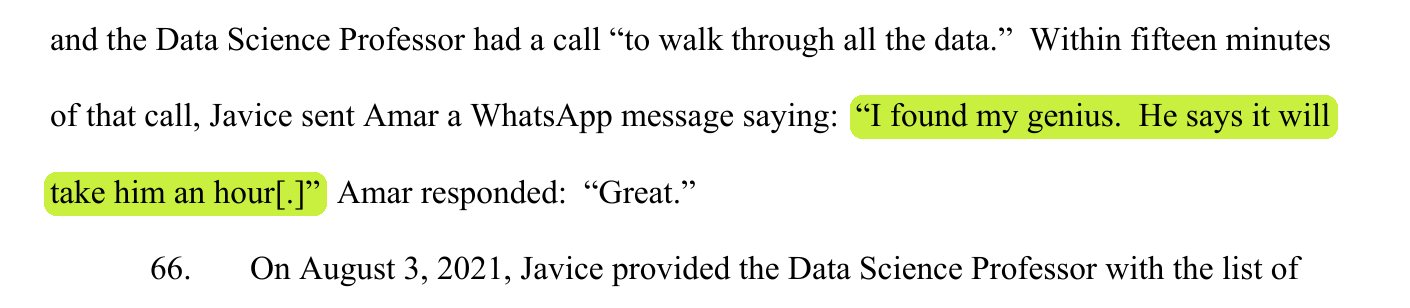
    Page 15, ¶65: “I found my genius. He says it will take him an hour[.]”
  12. 12Page 16 of 31 · ¶68

    Random names, checked so none were real.

    Page 16, ¶68: ensure none of the sampled names are real.
  13. 13Page 16 of 31 · ¶71

    Real emails were too hard to fake, so the email column became a “unique ID”.

    Page 16, ¶71: “unique ID.”
  14. 14Page 16 of 31 · ¶70

    The professor himself warned it would look fishy if anyone audited it.

    Page 16, ¶70: “would look fishy”
  15. 15Page 17 of 31 · ¶73

    2 days later: exactly 4,265,085 fake users.

    Page 17, ¶73: exactly 4,265,085 “user” accounts
  16. 16Page 13 of 31 · ¶53

    Their checker counted the rows ...

    Page 13, ¶53: “[h]ow many UNIQUE customer accounts exist.”
  17. 17Page 17 of 31 · ¶76

    ... and checked every box was filled in.

    Page 17, ¶76: “populated versus null/blank.”
  18. 18Page 17 of 31 · ¶76

    Every box was: 100%.

    Page 17, ¶76: 100% of the 4,265,085 entries
  19. 19Page 17 of 31 · ¶79

    Not in the video: his invoice said $13,300. She had him send one for $18,000, with “just one line item for data analysis”.

    Page 17, ¶79: $18,000
  20. 20Page 20 of 31 · ¶90

    To cover it, she bought real students' data: 2.3 cents a name.

    Page 20, ¶90: 2.3 cents per user. [$]105k price.”
  21. 21Page 24 of 31 · ¶112

    What caught her: JPMorgan emailed 400,000 of those names.

    Page 24, ¶112: sampled 400,000 names
  22. 22Page 24 of 31 · ¶112

    28% arrived ...

    Page 24, ¶112: only 28% of the emails were confirmed
  23. 23Page 24 of 31 · ¶112

    ... and 1.1% of those were opened. About 1,200 people.

    Page 24, ¶112: just 1.1% of those were opened

What happened next

Source: U.S. Attorney's Office, Southern District of New York, press release 25-227, Sept. 29, 2025 (archived copy). The ~1,200 opened emails is our arithmetic: 400,000 × 28% × 1.1% = 1,232 (the filing's percentages are rounded).

My take

JPMorgan checked the boxes, not the people. If you pay anyone for customers (leads, followers, an agency's “results”), email 10 of them before you pay. Real people answer.







